Showing posts with label Athletics. Show all posts

Wednesday, April 9, 2014

Malaysians Poor Show : Atheletics Incheon


LEE Hup Wei's debut outing this year was nowhere near his best as none of the five national athletes who have finished their events made an impression at the Australian Athletics Championships in Melbourne.
Hup Wei, who last competed at the Malaysian Open last September before suffering an injury, only managed to clear 2.12 metres yesterday before crashing out at 2.16m

It was far from the qualification mark of 2.20m for the Glasgow Commonwealth Games and Incheon Asian Games.

Nauraj Singh Randhawa, who has already qualified for the two multi-event Games, also failed at 2.16m to place sixth overall, one spot ahead of Hup Wei.

The Malaysian Athletics Federation sent seven athletes Down Under in a bid to have them qualify early for the Commonwealth Games but might as well have kept them home.

Sea Games silver medalist Casier Renee Kelly missed out on making the women's hammer throw final by 25 centimetres on Thursday, the opening day of the four-day meet, after posting 46.61m, more than six metres off her personal best.

Men's hammer thrower Jackie Wong finished eighth after a 54.66m effort on Friday, more than five metres below the national record he set in winning Sea Games bronze last December.

Worse was to follow for pole vaulter Iskandar Alwi, who failed to set a mark after failing to clear his opening height of 4.60m, though luckily for him he had already booked his ticket to Glasgow and Incheon.
Two more athletes will take to the field today when shot putter Adi Alifuddin Hussin and women's high jumper Yap Sean Yee attempt to put on a better show than their national teammates. By Devinder Singh


Read more: ATHLETICS: Malaysians put up poor show - Other - New Straits Times http://w1.nst.com.my/sports/other/athletics-malaysians-put-up-poor-show-1.551781#ixzz2ySYt3vnn
read more...

Friday, November 22, 2013

Saudi Arabia bans two over suspect biological passports 

RIYADH: Saudi Arabia’s Mohamed Shaween, who won men’s 1500m gold at the 2010 Asian Games, has been given a three-year ban for violating anti-doping regulations, the Saudi Arabian Anti-Doping Committee (SAADC) said.
read more...

Friday, June 3, 2011

OGQ support for hurdler Ashwini

Asian Games 2010 women's 400m hurdles champion Ashwini Akkunji
Asian Games 2010 women's 400m hurdles champion 
Asian Games 2010 women’s 400m hurdles champion, Ashwini Akkunji, is the latest addition to Olympic Gold Quest list of talented sportspersons to receive support with an eye on the London Olympics 2012. Specialised medical support and nutrition to meet her entire training requirements will be the focal point.
CEO of Olympic Gold Quest, Viren Rasquinha, explained, “We believe that she has genuine potential to challenge for an Olympic medal in the women’s 400m Hurdles event. OGQ plans to help her with her entire training needs with focus on specialised medical support and nutrition,” Rasquinha said.
The Karnataka athlete competes in women’s hurdles and is part of the Indian relay quartet.
“Ashwini has improved by leaps and bounds. Her built and running style are perfectly suited to the 400m hurdles event. We are delighted to have her as part of the OGQ program,” Rasquinha said.
Ashwini, 23, from Siddapura, Udupi district, attracted attention last year with a stunning display in the 400m hurdles at the Asian Games 2010, clocking a personal best 56.15 seconds against top-class international competition. China’s Wang Xing (56.76s) and Japan's Satomi Kubokokura (56.83s) finished behind her for the silver and bronze.
The lean runner won the 400m relay gold medals in the CWG 2010, New Delhi and 2010 Asian Games, Guangzhou. Ashwini said: “The last seven-eight months have been like a dream for me after winning gold at the CWG and the Asian Games. I’m grateful to all the girls in the 4x400m team, our coach Yuri, the AFI and Sports Ministry.”
She added: “OGQ support has arrived at the perfect time as my preparations for the Olympics 2012 have begun. I am pleasantly surprised at the pace at which OGQ moved to get specialised treatment for my injured wrist and to get procure nutritional supplements not available in India.”
Olympic Gold Quest is a Not For Profit Foundation that supports the training and preparation of 25 sportspersons across four individual Olympic sports (badminton, boxing, shooting and athletics), as part of the mission to help Indian athletes win Olympic gold medals.
OGQ’s Board of Directors comprises of Geet Sethi (eight-times World Billiards Champion, Khel Ratna and Padmashree awardee), Prakash Padukone (All England Champion and Padmashree Awardee), Leander Paes (12-times Grand Slam Champion), Viswanathan Anand (four-time World Chess Champion), Niraj Bajaj (four-time National Table Tennis Champion, Arjuna Awardee and Chairman, Bajaj Group of Companies).
Others on the board include R Ramaraj (Senior Adviser, Sequoia Capital India), Shitin Desai (Vice Chairman, DSP Merrill Lynch), Rakesh Khanna (Founding Partner, Ambit RSM), Neeraj Bharadwaj (Managing Director, Accel Partners) and Deepika Padukone (Actor).
read more...

Thursday, March 10, 2011

Udupi: Golden Girl Ashwini Eyes Olympic Gold

Daijiworld Media Network – Udupi (SP)
Udupi, Mar 10: Ashwini Shetty Akkunji, who has made the country proud by winning gold medals at the Commonwealth and Asian Games, said that she has now been concentrating on winning gold in the next Olympics, and that she has been practicing hard for the same. She was speaking during her visit to Srikrishna Mutt here on Wednesday March 9.
Ashwini said that her chances of bagging a medal at Asian Championship being held in Japan are not bright because of the paucity of time for practice. She revealed that the fracture she suffered during a practice session in Bangalore about two months ago to her hand is yet to heal fully, and that this has also been affecting her performance.
She expressed happiness at being chosen as the brand ambassador of Corporation Bank, and expressed the confidence that this will be a stepping stone for her future achievements, as the bank will be extending her all the assistance she needs for her practice and achievements.
read more...

Sunday, January 2, 2011

Ashwini aims Olympic medal, rues lack of sponsor


New Delhi:  India's new track sensation Ashwini Akkunji on Thursday rued lack of corporate sponsorship even after winning two gold medals in last month's Asian Games but still remains upbeat about a podium finish in the 2012 London Olympics.

Ashwini wants to become the first Indian woman athlete to win an individual gold in the Olympics but for that to happen she said she needs money to compete in the European circuit and top IAAF events.

"I want to become the first Indian woman athlete to win gold in Olympics. I have switched on to 400m hurdles just six months ago and my timing is very good. I can only improve from here. With some improvement in my technique I think I can cut down my timing by another two seconds at least and that should put me in medal contention in London," Ashwini said.

"I need to compete in the European circuit, in big events like Diamond League of the IAAF to improve upon my timing before the London Games. For that I need financial support but corporate sponsorship is not coming. I am looking for that," said Ashwini, who won gold in 400m hurdles and helped the 4x400m relay team to win a yellow metal in the Asian Games.


No now Ashwini has bit of a relief after Infinity Optimal Solutions (IOS) has offered her a deal of Rs. 15 lakh for a year to become their brand ambassador.

IOS has taken the bio data of Ashwini and she has asked the company to give the details of the terms and conditions for the deal.

The 23-year-old from Siddapura village of Udipi district in Karnataka is upbeat that she can cut down a few seconds from her 56.15 effort in Guangzhou by reducing the number of strides between the hurdles and using both the legs to clear them.

Ashwini's leading leg to clear hurdles has been the left one since she first ran in a 400m hurdles in Kochi in May and she will work out along with her coaches to use right leg also to cut down her timing.

It is a common practice of world class hurdlers to interchange their leading legs during a race to preserve energy as using only one leads to loss of stamina towards the home stretch.

 "I took to 400m hurdles from May only on the advice of my coaches (Yuri Ogorodnik of Ukraine and R S Sidhu) as they thought my long strides would suit for the event. I am hoping to cut down at least two seconds before London Games and that should put me in contention for a medal. Winning gold or not depends on the performance of the day," Ashwini gushed with confidence.

"I am using only the left leg to clear the hurdles but I will work on using both legs. If you are using only one leg you become tired towards the home stretch. Using both legs gives you the strength for the final flourish. I am now running with 15 strides in between the hurdles.

"I will work on running the first five hurdles on 14 strides and the rest five on 15 and that way I should be able to cut down at least two seconds," explained Ashwini.

Ashwini ran 56.15 secs in Guangzhou but she has to run sub-54 secs if she wants to be in contention for a medal in the 2012 Olympics.

The gold winner in Beijing Olympics had clocked 52.64 secs while the silver and bronze winners had timed 53.70 secs and 53.84 secs respectively.

Ashwini's coach R S Sidhu said she can cut three seconds with the technique as has been explained by her.

"If you are using only one leg you become tired towards the home stretch and so you need to change your leading leg to give you strength at the later half of the race. We are thinking she can cut down three seconds," Sidhu said.

One mark Ashwini said she will better in the lead up to the London Olympics is the national record of 55.42 secs in the name of legendary P T Usha, whom she said has inspired her to take to athletics.

"I was inspired to take to running after watching P T Usha and Ashwini Nachappa. I had grown up with stories of them bringing laurels for the country. If I can bring down my timing by at least two seconds then her (Usha's) record will be bettered. That is a bonus," said the lanky athlete, who took to running after she was first admitted at a sports school at Vidyanagar in Banaglore as a 13-year-old in 2000.

Ashwini said she wants to improve he timing in the Asian Championships in Japan in July next year and the World Championships in South Korea in August-September.

"Asian and World Championships are two big events. I want to improve my timing there. There I should be able to know where I am and how I am improving," she said.

She is also happy that Indian track and field athletes have produced impressive performances in both the Commonwealth Games and Asian Games.

"We have done really well in athletics in the CWG and Asian Games. I am really happy for that. There are sports other than cricket in which Indians can do well. I see athletics becoming a big sports in India in the next 10 years," Ashwini added.

It also makes runners to adjust themselves whenever the number of strides between hurdles has been increased or decreased from what they used to have. 
read more...

Saturday, December 11, 2010

Sad state of athletics

BRUSHING shoulders with the ‘Flying Doc’ Tan Sri Dr Mani Jegathesan at the recent Asian Games in Guangzhou evoked mixed feelings about Malaysian sports.

It felt good standing beside the man who sprinted to the country’s first-ever Asian Games gold medal – in the 200m – at the 1962 Jakarta Asiad. (In the 1966 Bangkok Asiad, he won the 100m, 200m and 4x100m gold medals.)

It was also a thrill to be in his company to witness Malaysia’s current generation of athletes achieve their best-ever outing of nine gold medals in Guangzhou.


Below the bar: Pole vaulter Roslinda Samsu is one of the Malaysian athletes who failed to shine at the recent Asian Games in Guangzhou.
 
But his presence also exposed a harsh reality – Malaysian athletics is down in the doldrums.
In his day, Malaysian athletics was the pride of the nation, as were many other sports like football and badminton.

There were other track and field gems too, like Datuk M. Rajamani, Rabuan Pit, Ishtiaq Mubarak and Zaiton Othman, just to mention a few.

Malaysian athletics then was able to replace fading and aging stars with young and bright talent.
While Jegathesan has gone on to earn the status of a respected sports figure in the Asian region, the current athletics scene in the country has only gone downhill.


At the Aoti Main Stadium in Guangzhou, where China’s icon Liu Xiang ran an explosive race to win the 110m hurdles to the thunderous cheers of his adoring home fans, Malaysia’s Jalur Gemilang was sadly nowhere to be seen.

There were only red-faced Malaysian officials, dashed hopes and another piece of evidence of the country’s waning prowess in the blue ribband sport for the world to see.

The athletes, who are showered with all kinds of grants and assistance, are not the only one to blame.
The Malaysian Amateur Athletic Association (MAAU) need to share the blame, having failed to get their act right despite repeated meetings and brain-storming sessions in search of solutions.
And why the MAAU’s official are not doing anything concrete to restore the bruised, battered and tattered image of athletics is beyond comprehension.

Athletics is no longer as popular in schools, colleges and universities as it used to be. The only noises coming from the MAAU are ones of bitterness, bickerings and back-stabbings.

Enough said of the sad state of athletics.

Another aspect of the Guangzhou Asiad that really stood out was the presence of their volunteers.
A total of 6,000 students, ages ranging from 18-22, went out of their way to make the Asian Games a memorable one.

They endured long hours – and without pay, mind you – but their lovely faces never failed to flash the most genuine of smiles.

“It is our pleasure to help you,” was always their heartfelt and humble answer.
If only we could find such enthusiastic bunch of youngsters willing to work for free when we hold such sporting events.

Come to think of it, most of our Nationals Sports Associations (NSAs) are manned by volunteers as well.
Take Jegathesan for example. He is the Olympic Council of Malaysia (OCM) deputy president and he was in Guangzhou heading the Olympic Council of Asia (OCA) medical committee.

Volunteers like Jegathesan are a dying breed in Malaysia, where we have an aging and seriously depleting numbers of volunteers.

And those who do come to help are mostly driven by monetary returns – and not for love of the game.
Old dinosaurs still warm the seats of most NSAs while youngsters are too busy with everything else except sports, thus our dependancy on people like Jegathesan to continue managing the associations.

The National Sports Council (NSC) are expected to receive a bigger budget from the government following the success of meeting their nine-gold target in Guangzhou.

In fact, some lobbying is already taking place for Malaysia to host the 2023 Asian Games.

But rather than devoting all of the budget to the small number of elite athletes and investing on unworthy sports projects – like hosting the 2023 Asiad – the money should be pumped into unearthing new talents through grassroots development programmes.

Malaysia needs new blood – both athletes and sports officials – for a better future. The kinds that will make Jegathesan proud to pass the baton on to.
read more...

Monday, December 6, 2010

Asian Games 2010 (Strategies and Tactics of Middle-East)

Asian Games 2010

Strategies and Tactics of Gulf States.

As for the Middle-East, it was seen that many of the men in the middle distance and long distance events having former top Ethiopian or Kenyan runners running to specifically run for Qatar and Bahrain. If we look at the top three 5000m track winners of Asian Games 2010, the champion was from Bahrain(former Ethiopian) and the second and third position were from Qatar (former Kenyans).

An interesting fact to note is that in 2006 Asiad in Doha, the Kenyan-born runners won the men's 800m, 1500m, 5000m, 10,000m, 3000m steeplechase and marathon events. Apart from a bronze in the marathon, and two minor medals in the 800m, all the male podium finishers were African.

For the year 2010, Bahrain won the men's 5000, 10,000 and 3000m steeplechase. Bahrain should thank the two former Kenyans (Ali Hasan Mahboob, Tareq Mubarak Taher) and one Ethiopian-born athlete (Bilisuma Shugi Gelassa).
Picture  1 - Ethiopian-born Mimi Gebregeiorges, the 5000m winner dashed hopes of Preeja, from India, of getting the second gold. Mimi ran for Bahrain.


The Gulf kingdom also claimed gold when Maryam Jamal won the 1500m women finals while in the 5000m, Mimi Gebregeiorges won the race. Both were formerly from Ethiopia.

Picture 2 - Maryam Jamal came in first in Asian Games 2010 (1500m women finals)

As for Jamal, who unsuccessfully applied for citizenship in the United States, Switzerland and France before settling on Bahrain, the country's flag an athlete might fly was of little matter, as long as you won. She said ,"Nationality is not important. What counts more is good practice instead of where I come from." Mohammed Shaween, the men's 1500m winner supports Jamal's statement by saying, "I think the competition is quite important," he said when quizzed about his feelings about African athletes changing allegiances.

Picture 3 - Mohammed Shaween is the winner of 1500m men.


"If there is a country providing a chance to train the athletes, I think it doesn't matter which country the athletes represent." It is also known that long distance runners, however, spend more time training, ironically, in the countries of their birth as the lack of altitude and inclement hot temperatures of the Middle-East states make it impractical.

The running under the flag of a borrowed nationality has several advantages. Often competition for places in their home countries is so strong that they might never appear internationally. This is especially so in countries like Ethiopia and Kenya.

There is also the lure of better pay, win bonuses and expenses paid beyond the realms of what they could earn at home.

"You have to look for where you can be looked after," 5000m silver medallist James Kwalia said, adding that facilities in his homeland of Kenya were not as good as in Qatar, for whom he now runs.

Picture  3 - In the 5000m race, James Kwalia, second from left, is a true bred Kenyan, who ran for Qatar in the Asian Games 2010 and became a silver medalist.


Gulf officials were able to rebut back on complaints over athletes switching nationalities, saying that European countries and the United States have long been naturalising other countries' runners for their own purpose.
read more...

Friday, November 26, 2010

Asian Games: Bahrain win double gold in athletics


GUANGZHOU, China: Bahrain's imported talent notched up two prestigious long-distance titles at the Asian Games on Friday, but there were no doubles for Ali Hasan Mahboob or India's Preeja Sreedharan.

Mahboob, previously known as Kenyan Silas Kirui before changing allegiance to Bahrain, had wrapped up the 5,000m title in the week and came into the 10,000m as defending champion and favourite.

But the pace set by Qatar's Kenyan-born Essa Rashed cut him out of contention, little-known Ethiopian-born teammate Bilisuma Gelassa just getting past the Qatari for gold in a last-gasp sprint for the line.

Mahboob clung on to claim bronze and ensure a podium, like that of the men's 5,000m, made up of three African-born runners.

"I'm not satisfied with my performance today because I should have got the gold medal," said Rashed, blaming his faltering pace at the end on stomach pains.

"I tried to push myself but I didn't manage to make it so I fell behind."

In the women's 5,000m, there was similar heartbreak for Sreedharan, the newly-crowned Asiad 10,000m champion, who mistimed her sprint finish by a matter of two metres and had to be happy with silver behind Bahrain's Mimi Gebregeiorges.

As the Ethiopian-born Gebregeiorges neared the line, it was obvious she didn't have much more to give, but Sreedharan had gifted her too much coming around the bend from 250 metres.

China's defending champion and current Asian champ Xue Fei could only finish in seventh position, almost 29sec off the pace.

"I got the bronze in the 1,500m and gold in the 5,000m, so it's very good. I feel very happy," said Gerbregeiorges, who like Gelassa only acquired Bahraini nationality in 2009.

"I looked behind and I saw that she was coming fast and I killed myself to reach the line," the 22-year-old said of Sreedharan's late push for the finish line.

Preeja was left kicking herself: "If I'd followed the Bahraini immediately when she stepped up the pace I could have caught her."

The relays saw Yao Li become the first Chinese male athlete to win two gold medals in athletics in one Asiad when he raced home for the host country's first 4x100m relay victory since the 1990 Asian Games in Beijing.

The relay gold, coupled with Li Yanxi's successful defence of his triple jump gold crown, with a season's best of 16.94m on his penultimate leap, means China top the athletics medals table with 12 golds, 14 silvers and eight bronzes, with just the men and women's marathons to be run on Saturday.

Indian Ashwini Akkunji also claimed a second gold running the third leg of India's victorious women's 4x400m relay team to add to her individual 400m hurdles title.

But there was no third gold for Japan's sprint queen Chisato Fukushima, who was left too much to do down the final stretch of the women's 4x100m relay, won by Thailand, with China getting silver.

Saudi Arabia won the men's 4x400m relay.

In the field, there was a welcome 1-2 for Uzbekistan in the women's high jump, Svetlana Radzivil pipping teammate Nadiya Dusanova by 2cm with her best of 1.95m.

Japan's Yukifumi Murakami won the men's javelin with a personal best of 83.15m after two silvers in previous Asiads.

The men's shot put crown was easily wrapped up by Saudi Arabia's Asian record holder Sultan al-Habashi, his sixth and final effort measuring 20.57m.
Men's 10,000m final:
1. Bilisuma Shugi Gelassa (BRN) 27 minutes 32.72 seconds
2. Essa Rashed (QAT) 27:33.09
3. Ali Hasan Mahboob (BRN) 27:40.07
Men's Triple jump final:
1. Li Yanxi (CHN) 16.94 metres
2. Yevgeniy Ektov (KAZ) 16.86
3. Cao Shuo (CHN) 16.84
Men's Javelin final:
1. Yukifumi Murakami (JPN) 83.15 metres
2. Park Jaemyong (KOR) 79.92
3. Rinat Tarzumanov (UZB) 79.65
Men's Shot Put final:
1. Sultan al-Habashi (KSA) 20.57 metres
2. Zhang Jun (CHN) 19.59
3. Chang Ming Huang (TPE) 19.48
Men's 4x100m relay final:
1. China 38.78 seconds
2. Taiwan 39.05
3. Thailand 39.09
Men's 4x400m relay final:
1. Saudi Arabia 3 minutes 02.30 seconds
2. Japan 3:02.43
3. China 3:03.66
Women's 5,000m final:
1. Mimi Gebregeiorges (BRN) 15 minutes 15.59 seconds
2. Preeja Sreedharan (IND) 15:15.89
3. Kavita Raut (IND) 15:16.54
Women's High jump final:
1. Svetlana Radzivil (UZB) 1.95 metres
2. Nadiya Dusanova (UZB) 1.93
3. Anna Ustinova (KAZ) 1.90
3. Zheng Xingjuan (CHN) 1.90
Women's 4x100m relay final:
1. Thailand 44.09 seconds
2. China 44.22
3. Japan 44.41
Women's 4x400m relay final:
1. India 3 minutes 29.02 seconds
2. Kazakhstan 3:30.03
3. China 3:30.89

- AFP/ir/de

read more...

Thursday, November 25, 2010

Ashwini wins gold in women's 400m hurdle & Joseph Abraham fetches gold in 400m men's hurdles

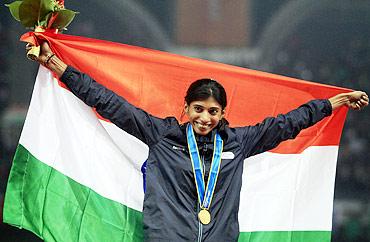
India's Ashwini Chidananda Akkunji celebrates with her gold medal after winning the women's 400m hurdles event at the 16th Asian Games in Guangzhou
Ashwini Chidananda clocked a personal best 56.15sec to clinch an unexpected gold medal for India in the women's 400m hurdles event.
The 23-year-old is a 400m and 4X400m relay runner specialist and was part of the team that won the gold medal in the Commonwealth Games last month.
Ashwini, who started running 400m hurdle in May at the National Open Athletic meet in Kochi, is only the third Indian to win a gold medal in this category.
MD Valsamma was the first Indian woman to win the 400m hurdles in 1982 New Delhi Asiad, while the legendary PT Usha repeated the show in 1986 at Seoul.
While Ashwini raced away with her first international individual gold medal in 400m hurdle, her compatriot Jauna Murmu was not so lucky as she missed the bronze by a whisker after clocking a personal best of 56.88. 
Jauna was 0.05 points behind third-placed Satomi Kubokura of Japan. Chinese Wang Xing won the silver.

Image: India's Ashwini Chidananda Akkunji celebrates with her gold medal after winning the women's 400m hurdles event at the 16th Asian Games in Guangzhou

India's Joseph Ganapathiplackal Abraham celebrates winning the men's 400m hurdles final at the 16th Asian Games in Guangzhou
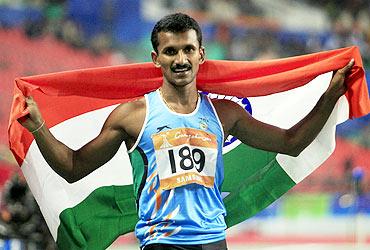
Joseph Abraham clocked a season's best of 49.96sec to clinch the gold medal for India in the men's 400m hurdles event.
The 29-year-old Indian's effort was, however, still short of the national record of 49.51sec he set during the 2007 World Championships in Osaka. 
The silver went to Saudi Arabia's Bandar Yahya Sharahili, who clocked 50.29sec.
Japan's Naohiro Kawakita settled for the bronze medal with a timing of 50.37sec.

Image: India's Joseph Ganapathiplackal Abraham celebrates winning the men's 400m hurdles final at the 16th Asian Games in Guangzhou
read more...

Wednesday, November 24, 2010

Asian Games: Liu wins 110m hurdles as another drugs case tars Games


GUANGZHOU, China: Superstar hurdler Liu Xiang won redemption on Wednesday in front of home fans for his Beijing Olympic disaster by claiming Asian Games gold on a day tarnished by a second positive doping test.

On day 12 of the showpiece multi-sports event, dominant table-toppers China made the Guangzhou Games its most successful ever in terms of total medals.

Li Caixia's gold and Li Ling's silver in the women's pole vault were the 343rd and 344th for the hosts, surpassing the previous record of 342 that China won in Beijing in 1990.

China is also on course to beat its best ever haul of gold, which stands at 183 in the Beijing Asiad. They now have 173 with three days left.

Liu contributed to his country's tally by winning the 110m hurdles in front of 80,000 screaming fans at Aoti Main Stadium and an estimated television audience of up to 600 million.

The former Olympic champion and world record holder crossed the line in a season-best time of 13.09 seconds ahead of teammate Shi Dongpeng (13.38) and South Korea's Park Tae-Kyong (13.48).

It was Liu's third successive Asiad gold after claiming the title in 2002 and 2006.

His win came 27 months on from his calamitous outing in Beijing, when he limped out of his heat with an Achilles tendon injury to shatter the hopes of a nation.

"I didn't expect to run 13.09. I thought of running about 13.20," he said.

"We are very proud to add a gold and a silver medal to the Chinese team."

His gold was one of three China won in track and field, including Li's pole vault triumph.

Su Xiongfeng denied double defending champion Hussain al-Saba of Saudi Arabia a third title with a best of 8.05m in the men's long jump while Iran's Ehsan Hadadi defended his discus title with a best of 67.99m.

Meanwhile, Uzbek wrestler Jakhongir Muminov became the second athlete to fail a drugs test.

The 23-year-old did not win a medal.

"The athlete has been disqualified from these Games and his performance has been nullified," said Dr. Mani Jegathesan, chairman of the Olympic Council of Asia's medical committee.

The Asiad, which began on November 12, has seen one previous drugs scandal, also involving an Uzbek athlete who was also named Muminov, although they are not related.

Judoka Shokir Muminov won a silver medal but had it taken away after testing positive for methylhexaneamine, a stimulant which was the same drug involved in Wednesday's case.

South Korea are second in the medals table and its coaches and competitors were told to maintain cordial relations with rival athletes from North Korea after an artillery attack on a South Korean island Tuesday.

"I told coaches that our athletes should just act normally around or with North Korean athletes," said Lee Kee-Heung, head of the South Korean athletic delegation, according to Yonhap news agency.

"We're all here to play sports. We don't need to react to the situation back home. This (Asiad) is a platform for sports."

North and South Korean athletes went head-to-head on the wrestling mats, with the four-minute duel sealed by a handshake and a lukewarm embrace.

North Korean Yang Chun-Song came out on top in a bout with the South's Kim Dai-Sung.

Defending champions China, meanwhile, achieved a hat-trick of women's field hockey gold medals by ousting South Korea 5-4 in a penalty shoot-out.

Elsewhere, Malaysia's Puvaneswaran Ramasamy won the 55kg kumite (sparring) gold to become the first karate competitor to climb the podium at five straight Asian Games.

- AFP/ac/de

read more...

Asian Games: Imura falls short in long jump, no gold for Japan in athletics

Japan's Kumiko Imura competes in the women's long jump event, at the 16th Asian Games in Guangzhou, China, Tuesday, Nov. 23, 2010. (AP Photo/Ng Han Guan)
GUANGZHOU, China (Kyodo) -- Kumiko Imura had to settle for fifth place in her failed attempt to win a second consecutive Asian Games long jump title Tuesday as South Korea's Jung Soon Ok prevailed with a leap of 6.53 meters.
Japan ended the third day of athletics without a gold medal as Hiromi Takahari, Yuki Nakata and Masumi Fuchise came closest with silvers in the men's high jump, the women's heptathlon and the women's 20-kilometer walk, respectively.
Imura jumped 6.37 meters in her first and third attempts but fell shorter in her remaining three attempts at Aoti Main Stadium.
"I was in form coming into this event," the 29-year-old Beijing Olympian said. "I just couldn't perform the way I wanted to. I couldn't really control the speed of my run-up. I was slow sometimes, fast at others.
"I need to have the mental strength to do well in big events. Over the past few years, I even thought about retiring because I really struggled with my jump. But now I'm prepared to go through the rough. I know I can grow as a person and as an athlete."
Japan's Hiromi Takahari competes in the men's high jump event, at the 16th Asian Games in Guangzhou, China, Tuesday, Nov. 23, 2010. (AP Photo/Ng Han Guan)
In the men's high jump, Qatar's Mutaz Essa Barshim took the gold by clearing 2.27 meters, while Takahari finished with 2.23 meters.
"I have mixed feelings of satisfaction and disappointment," Takahari said. "There was a jump I thought that I cleared 2.27 meters on."
In the women's heptathlon, Nakata had a total of 5,606 points for the silver. Yuliya Tarasova of Uzbekistan struck gold with 5,783.
In the morning session, Fuchise finished 28 seconds behind winner Liu Hong of China, who crossed the finish line in 1 hour, 30 minutes, 6 seconds, in the women's 20-km walk.
Yuka Murofushi, the younger sister of Athens Olympic hammer throw champion Koji Murofushi, was sixth in the women's discus throw.
Japan failed to qualify for Friday's final in the men's 4x100m relay after missing the handover between the second and third runners.
Japan had won a medal in the event in each of the past eight Asian Games.
"I just don't know how we made that mistake until we look at the video later," said Shinji Takahira, a member of the bronze medal-winning 4x100 relay team at the Beijing Olympics.
"I know I'm not supposed to make excuses, but we formed this team without proper preparation. We have to reflect on this disappointing outcome. If we want to accomplish something, we need to commit."
(Mainichi Japan) November 24, 2010
read more...

Tuesday, November 23, 2010

Saudi runner takes men's 1,500 Asian Games title

Maryam Jamal AVIVA GRAND PRIX - BirminghamImage via Wikipedia
Mohammed Othman Shaween came from behind to defend his title in the men's 1,500 meters at the Asian Games on Tuesday, while a strong finish by Maryam Yusuf Jamal brought her the women's gold with room to spare.
Shaween took over on the last lap from Saudi Arabia teammate Emad Hamed Noor, who led for the first three laps then faded at the end, and finished at 3 minutes, 36.49 seconds. Finishing second was Sajad Moradi of Iran at 3:37.09. The bronze went to Belal Mansoor Belal Ali of Bahrain at 3:38.39.
"I expected it to be harder, but it still wasn't easy," Shaween said. "Our Iranian colleague was tough. I was out with an injury until August, but that was lucky for me because I was in good shape for this race."
Shaween said Noor suggested the winning strategy.
"He asked me to be patient, follow him and rush in the last 100 meters," Shaween said.
In the women's race, Jamal, the 2009 world champion, and Bahrain teammate Mimi Belete Gebregiorges moved to the front of the pack on the final lap. Jamal sprinted on to win in 4 minutes, 8.22 seconds. Vietnam's Thanh Hang Truong overcame Gebregiorges in the final 50 meters to claim the silver, at 4:09.58.
"We didn't discuss the race beforehand, we just ran the way we felt," Jamal said.
Both of the Bahrain athletes formerly competed for Ethiopia. But Jamal said she did not switch to find easier competition.
"It's not about where you race," Jamal said. "It's about how hard you train."
Another Bahrain runner claimed gold in the men's 3,000-meter steeplechase, with Tareq Mubarak Salem Taher crossing the line in 8:25.89 to beat Thamer Kamal Ali of Qatar, who was 8:26.27.
Yuliya Tarasova of Uzbekistan, who also took bronze in the long jump, won the women's heptathlon with 5,783 points.
The field event winners Tuesday were an international smorgasbord.
South Korea's Jung Soon-ok, who was fifth in the 2006 Asian Games but failed to qualify for the World Championships last year, took the women's long jump with a leap of 6.53 meters; host China's Li Yangfeng won the discus gold at 66.18 meters; Qatar high jumper Mutaz Essa Barshim, the Asian junior champion, cleared 2.27 meters to claim a win.
All the winning marks were well off regional and world records, prompting criticism that the Asian Games, an Olympic-style event held once every four years, are not producing results fitting for a continent that represents two-thirds of the world's population.
"The quality of the competition is good, but one of the problems that we have in Asia is that our season is too long," 1,500 champion Shaween said. "The Americans and Europeans are finished now, but we in Asia don't know when we are supposed to finish. This is especially a problem for us in my region."
read more...

Monday, November 22, 2010

Lao Yi fastest in Asia, Suryo only sixth

Outclassed: China’s Lao Yi runs ahead of Indonesia’s Suryo Agung Wibowo to win the men’s 100 meters final at the 16th Asian Games in Guangzhou, China, on Monday. Reuters/David GrayOutclassed: China’s Lao Yi runs ahead of Indonesia’s Suryo Agung Wibowo to win the men’s 100 meters final at the 16th Asian Games in Guangzhou, China, on Monday. Reuters/David Gray Chinese sprinter Lao Yi claimed himself as Asia’s fastest man at the Aoti Main Stadium on Monday by clocking 10.24 seconds to snatch gold, followed by Alnashi Yasir Baalghayth of Saudi Arabia at 10.26 and Al Harthi Barakat of Oman at 10.28.
It was a different story for Indonesian sprinter Suryo Agung Wibowo, a two-time Southeast Asian Games winner, who finished sixth at 10.37 seconds. His time was far behind his personal best of the 10.17 seconds he set at the 2009 SEA Games in Vientiane, Laos.
“I started late so I had to chase them afterward. I don’t know why, and I was ready and fully focused. If my start was better, the result would be different,” Suryo said.
“The replay on the screen shows that I looked ‘lost’ in the first step and that’s what I felt.”
With the 16th Asian Games nearing its end, Indonesia only added another silver from the bowling lane with the women’s team of five finishing second after almost four hours of competition at Tianhe Bowling Hall.
Indonesians Tannya Roumimper, Novie Phang, Lvana Hie, Sharon Santoso and Putty Armien scored 6,340 points compared to South Korea’s 6,711 and Malaysia’s 6,295.
In the men’s team of five, the 2006 Doha Games men’s singles gold medalist Ryan Lalisang and teammates unexpectedly finished ninth. South Korea won the gold medal after scoring 6,654 points, followed by Malaysia with 6,579 and Hong Kong with 6,475.
Earlier in the day, national cyclist Ariehaan Hilman only finished 23rd in the  men’s individual road race in the Triathlon Venue while compatriot Tonton Susanto finished 35th.
The final phase of the 180-kilometer event was a neck-to-neck race among the medalists.
Wong Kam Po of Hong Kong won the race by clocking 4 hours 14 minutes and 54.18 seconds followed by Takashi Miyazawa of Japan with 4:14:54.33 and Zou Rongxi of China with 4:14:54.96.
For the women’s kayak double 500 meter pair, Indonesia’s old hands Sarce Aronggear and Rasima qualified for the final after finishing third in the first heat at the International Rowing Center by clocking 1:56.237 behind Japan pair Shinobu Kitamoto and Asumi Ohmura (1:44.642) and Korean pair Yoo Mi Na and Shin Jin Ah (1:52.487).
Sarce, however, failed to qualify for the women’s kayak single 200 meters after finishing fourth in the first heat.
Indonesian pair Silo and Muchlis, who helped win three golds in the dragon-boat race, failed to qualify for both finals of the men’s kayak double 1,000 meters and  men’s kayak double 200 meters.
Teammate Tarra Anwar only finished fifth in the men’s canoe single 200-meter first heat and failed to reach the final.
In two diving events at the Aoti Aquatics Center, Indonesian divers went home empty handed.
Muhammad Nasrulah and Noor Husaini collected only 315.51 points to stand sixth in the men’s synchronized 10-meter platform final.
Sari Ambarwati and Maria Natalia also finished sixth in the women’s synchronized 3-meter springboard final.
read more...

China relief as Liu clears his first hurdle at the Asian Games

Main Image
Main Image
Main Image
China's Liu Xiang runs to win his men's 110m hurdles heat at the 16th Asian Games in Guangzhou, Guangdong province, China, November 22, 2010.
Credit: Reuters/Michael Dalder
GUANGZHOU, China | Mon Nov 22, 2010 2:30pm EST
GUANGZHOU, China (Reuters) - Liu Xiang cleared the first hurdle on the road to defending his Asian Games title on Monday while local fans roared the hosts on to three track and field titles on the second night of athletics in Guangzhou.
China celebrated their first men's 100 champion in Lao Yi and applauded Liu, who has had little to celebrate since he limped out of the 2008 Olympics in a premature end to the defense of his 110 meters hurdles title.
He has been plagued subsequently by injuries and poor form but the 27-year-old remains hugely popular at home and expectations have grown in Guangzhou.
Greeted with thunderous cheers at Aoti Main Stadium, Liu repaid the faith by qualifying first for the final on Wednesday.
"I'm here to enjoy the atmosphere," said Liu, who warmed up in a black shirt emblazoned with "Hidden Strength" in Chinese characters and waggled his finger in front of trackside cameras.
"I expect to run in 13.20 (in the final). I'll try my best."
Liu, who has a personal best of 12.88 seconds, clocked 13.48. He will need to hold off the next fastest contender Park Tae-kyong of South Korea and Saudi Arabia's Ahmed Khader Almuwallad in the final. Compatriot and longtime rival Shi Dongpeng failed to fire in his heat but also remains a threat.
Liu's glittering cameo glossed over a disappointing day for some of the Games' other marquee names.
One of the competition's biggest drawcards, 1,500 meters world champion Yusuf Saad Kamel of Bahrain, crashed out of qualifying and blamed team officials for making him run with a painful knee injury.
"I'm not upset about my failure, but about their pushing me to run. I know that I can't achieve anything," said Kenya-born Kamel, who switched nationality in 2003.
CHINESE 100 GOLD
Qatar's Samuel Francis, a former Nigerian who holds the men's Asian record of 9.99 seconds, held his head in his hands after being disqualified for a false start in his heat.
That opened the door for Lao to win the men's 100 and the stocky 25-year-old draped himself in a national flag after burning home in 10.24 seconds. The hosts also celebrated titles in the men's pole vault and the women's hammer throw.
China's imperious diving team swept both the men's synchronized 10 meters platform and the women's synchronized 3 meters springboard.
Fencing and trampoline golds edged the hosts closer to their goal of 166 golds, one more than their haul at Doha and well within reach of their record 183 at the 1990 Beijing Games.

read more...

Sunday, November 21, 2010

Asian Games: Double gold for India on the opening day of athletics

Double gold for India on the opening day of athletics
India's Sudha Singh outsprints China's Jin Yuan to win the women's 3000m Steeplechase final at the 16th Asian Games in Guangzhou, China. (AP Photo)
GUANGZHOU: India opened its athletics campaign in the Asian Games in a spectacular fashion with long distance runners Preeja Sreedharan and Sudha Singh clinching the gold medals in the women's 10,000m and 3000m steeplechase at the Aoti main stadium on Sunday.

To add to the delight, Kavita Raut secured the silver medal behind Preeja in the in the 10,000m race at the Aoti Main Stadium.

28-year-old Preeja, belonging to Kerala's Idukki district, and Commonwealth Games bronze winner Kavita of Maharashtra ran a tactical race by staying back of the pack before making the final effort to put back the bunch of nine other runners and cross the finish line with personal best times.

Preeja clocked 31 minutes, 50.47 seconds, a good two minutes below the Asian and world record of China's Wang Junxia but better than her 32:04s set two years ago at the London Olympic Games qualifying meet.

"I feel very proud to have won the gold medal after missing out on a medal in the Commonwealth Games. I was very disappointed with the Commonwealth Games performance and was determined to do well in the Asian Games," said the short-statured Preeja.

"I am also happy for Kavita for getting the silver medal," she said but could not describe how she overtook the rest of the field at the end.

"I don't know. I just ran, that's all," she said. She also credited the Indian government and her coaches for the victory.

"I lost my father at a very young age and my mother brought us up. I have a brother and sister. She worked in others' houses to run the family," said Preeja.

"I also give credit to the government for the money it spent on the month-long training which we got. I also want to give credit to my coach Nikolai Snesarov of Belarus and the Sports Authority of India," added the golden girl.

Kavita, who too clocked her personal best of 31:51.44, also gave credit for her silver medal to the coaches and the government.

"I'm very happy. I got a medal in CWG and in the Asian Games too. I thank the government, the coaches and ONGC," said the 25-year-old Kavita.

The bronze in this event went to S Habtegebrel of Bahrain while Japan's Kayoko Fukushi, who set the early pace, and Hikari Yoshimoto finished fourth and fifth respectively.

To bring more cheers to the Indian camp was the thrilling victory of Sudha Singh in the day's final event -- the 3000m women's steeplechase -- which had only six runners in it. She also set a new national record in her effort.

The two Indians in fray -- eventual gold medallist Sudha and OP Jaisha, who ended up fifth, -- were abreast of the others in the bunch with Sudha setting the pace after 2000m.

24-year-old Sudha made the decisive kick on the back stretch of the final lap and was in fact leading her nearest rival, eventual silver medal winner Jin Yuan of China, comfortably after the last water jump by ten metres before the host nation's athlete accelerated to close the gap.

Sudha, who was flagging towards the end, saw the Chinese athlete closing down the gap and made one determined effort in the final few metres to put her leg just in front of the Yuan for the gold with a personal best timing of 9 minutes and 55.67 seconds.
Yuan secured the silver clocking 9:55.71 while the bronze went to Japan's Minori Hayakari (10.01.25).

"I never expected to win the gold medal. The Chinese girl gave me a tough fight in the end and I am happy to win the medal," Sudha said later at the press conference.

"I am happy to have improved my time clocked at the Commonwealth Games where I timed 9:57.63 and set a new national record," she said.

Earlier in the day, India's campaign in the blue riband discipline of athletics started on mixed note with high jumper Hari Sankar Roy making it to the final after men's 20km walkers Harminder Singh and Baljinder Singh finished outside the medal bracket.
Roy cleared 2.10m on his first attempt and qualified for the 12-man final to be held on November 23 while the second jumper Nikhil Chittarasu, who also cleared an identical height but only on his second attempt, was knocked out of the competition.

24-year-old Roy went through as the 11th best in the qualifying stage after failing to cross the bar when it was raised to 2.15 metres on all three attempts in Group B competition. Chittarasu also flopped at this height in Group A.

Qatar's Al Mannai Rashidahmed came out on top in the qualifying round by clearing 2.15m while nine other jumpers also soared over the height.

In men's 20-km walk race, the first medal event in the track and field event, India's Commonwealth Games bronze medallist Harminder and Baljinder could not keep up with the fast pace set by the leading bunch and finished sixth and seventh out of nine starters.

Harminder faded away past the 6km mark and clocked one hour, 26 minutes and 33 seconds, three minutes below his personal best of 1:23:00 achieved this season.

Baljinder clocked 1:28:06 and was trailing the leading bunch after only the fifth km.

Wang Hao of China won the gold in a season's best of 1:20:50, his teammate Chu Yafei took the silver in 1:21:57 while South Korea's Kim Hyunsub, who won silver in the 2006 Asian Games, bagged the bronze (1:22:47).

Park Chi Sung of Korea was disqualified by the technical officials for breaching the walk rule.

In other athletics event of the day, Manjeet Kaur and Mandeep Kaur qualified for the final of women's 400m to be held on Monday after managing to secure the last two berths in the eight-competitor field.

However, it was disappointment for India in the men's 400m race as Mortaja Shake and Bibin Mathew failed to make it to the final.

In the men's 5000m final too India cut a sorry figure as Sunil Kumar finished on the eighth position with a season's best of 14:01.76.

In the women's 100m Jyothi Hiriyur Manjunath made it to the semifinals, clocking 12.04 in the heats.

There was further good news for India in the track and field events today as Mohammed Abdul Najeeb Qureshi and Satish Krishnakumar Rane also entered the semifinals after clocking 10.50 and 10.64 in their respective heats.


read more...

Saturday, November 13, 2010

Adachi Takes Asian Games Title

Mariko Adachi was predicted for gold at the Asian Games and she did not disappoint, dominating today’s women’s triathlon competition in Guangzhou for the gold medal.
Photo: Triathlon.org
Her teammate Akane Tsuchihashi won the silver, capping off a spectacular day for Japan. Yun Jung Jang came across for the bronze winning Korea’s first ever triathlon medal at the Asian Games.
A small field of 11 women dove into Centre Lake at the University Town in Guangzhou and immediately, the strong Japanese women took the early lead. Adachi and Tsuchihashi exited the water more than 20 seconds ahead of the Korean swimmers Jang and Dan Bi Hong, along with Fan Dan of China.
Out onto the flat 40-kilometer bike course, Adachi and Tsuchihashi were unable to get away, resulting in a lead group of five women. After the first lap, they owned a commanding lead of almost two minutes over the first chase pack which included Hoi Long of Macau and Liu Ting of China.
The seemingly healthy lead of two minutes did not last. By the second last bike lap, Hoi and Liu’s hard work paid off as they pulled even with the leaders.
Seven women entered T2 together with Jang leading the way. Adachi was fourth to hit the hilly 10-kilometre run course but on the first lap, she surged to the front and never looked back.
Adachi dominated the run with the fastest split of the day and cruised to the finish line for Japan’s first medal of the 16th Asian Games.
“I was confident to break away from the group in the final run leg,” said Adachi. “All the effort we have done together with my teammates made this victory possible. I am really happy to win this race today.”
Tomorrow, Asian triathlon powerhouse Japan targets more medals in the men’s competition. Ryosuke Yamamoto and Yuichi Hosoda are favorites for gold but Korean upstart Min Ho Heo of Korea will look to pull off the upset.
The 16th Asian Games
Final Results – Women’s Triathlon
1.5km Swim, 40km Bike, 10km Run
1. Mariko Adachi (JPN) 2:05:44
2. Akane Tsuchihashi (JPN) 2:06:31
3. Yun Jung Jang (KOR) 2:07:52
4. Long Hoi (MAC) 2:08:21
5. Dan Fan (CHN) 2:08:47
Race recap provided by ITU.

read more...

Friday, November 12, 2010

Adachi takes gold in women's Asian Games triathlon

Logo of Olympic Council of AsiaImage via Wikipedia
GUANGZHOU, China — Mariko Adachi lived up to her status as pre-race favorite, powering away in the run leg to lead Japan in a gold-silver finish in the women's triathlon Saturday on the first morning of Asian Games competition.
Adachi finished fourth in world championship events in Sydney and Madrid this year and was ninth overall in the ITU championship, the best of any female Asian triathlete.
She won in 2 hours, 5 minutes, 45 seconds while her teammate Akane Tsuchihashi was second in 2:06.31. Jang Yun-jung of South Korea took the bronze in 2:07.52.
Adachi waited for Tsuchihashi to finish, then the Japanese pair, who belong to the same club team in Tokyo, held their hands in the air to wave to the crowd.
"The swim leg went exactly as planned, and in the cycle, we tried to exchange the lead a few times," Adachi said through an interpreter about her teammate. "In the run, I felt very strong. Now I feel very proud to get Japan's first gold medal.
Tsuchihashi said she admired her gold medal-winning friend.
"She is the model that I respect and should follow," Tsuchihashi said.
The race started at 9 a.m. and was held under mostly sunny skies and a temperature of 26 Celsius (79 Fahrenheit).
It included a 1.5-kilometer swim in Centre Lake at the University Town complex, followed by a seven-lap, 40-kilometer cycle on a flat course with tight turns and a 10-kilometer run that included several hills.
The men's race, which includes defending champion Dmitry Gaag of Kazakhstan, will be held Sunday.
Despite loud Chinese rock and rap music and such Western songs as Katrina and the Waves' "Walking on Sunshine" creating a party atmosphere at the packed finish line, both the cycle and run courses had a sparse smattering of spectators through the leafy university complex in Panyu district, about 10 kilometers from downtown Guangzhou.
The two Japanese women led out of the swim leg, but then were involved in a five-way tussle for the lead in the cycle leg. After four laps, Adachi and Tsuchihashi, Fan Dan of China, Jang Yun-jung of South Korea and Hoi Long of Macau were bunched, with Hoi and Fan in the chase group.
Hoi caught the pack and led for several kilometers at the hour-long mark of the race and into the sixth lap of the cycle before Jang powered away to lead out of the cycle leg transition in a time of 1:30.02, with Fan a second behind and Adachi two.
Adachi quickly made up the slight disadvantage, catching Jang within a half-kilometer and then taking a 20-meter lead that she easily extended, getting stronger as the run led progressed. She led by more than 30 seconds going into the final lap.
Enkhjargal Tuvshinjargal of Mongolia was the 11th and last competitor to finish the race, crossing the line 36 minutes after Adachi.
Copyright 2010 The Associated Press. All rights reserved. This material may not be published, broadcast, rewritten or redistributed.
read more...

Wednesday, November 3, 2010

High hopes for top Vietnamese athletes

Air time: Vietnamese Nguyen Thi Hien kicks the ball in the women's sepak takraw team final at the Asian Games in Doha, Qatar. Viet Nam will compete at the Asian Games in Guangzhou, China next month. � VNA/VNS Photo Ngoc Truong
HA NOI � Vietnamese athletes are ready to compete in next month's Asian Games to be held in Guangzhou, China deputy head of the National Sports Administration Le Quy Phuong said.
Athletes will be given random doping tests before the Asian Games begin on November 12-27.
Samples will be taken at the national training centres in Ha Noi, HCM City and Da Nang and sent for testing at a laboratory in Beijing as Viet Nam has not yet built a doping test centre.
Phuong, who will lead the team at the Asian Games, said athletes had taken medical advice during training to ensure that they had avoided banned substances.
"We have proposed a VND76 billion (US$3.8 million) doping test centre project, but it has yet to be completed. However, we must control drug use among athletes who will face testing at the games. At the Beijing Olympics two years ago, gymnast Do Thi Ngan Thuong tested positive for banned substances," Phuong said.
"Coaches and doctors monitored the use of drugs and medicines the athletes took during their training, to ensure they didn't use banned substances."
Thuong was banned from competition for a year after she tested positive for diuretic furosemide at the Beijing Olympics.
As the Asian Games is the crucial sporting event this year, the sports administration has increased daily food supplements for athletes from VND120,000 to VND200,000 over a three-month period.
Earlier, the administration also gave special nutritional supplements to the 60 athletes most likely to win medals at the games.
Viet Nam announced its 260-member squad to compete in 29 of the 42 events at the 16th Asian Games two weeks ago.
The country hopes to bring home four to six gold medals to finish 15th out of the 45 participating countries and territories.
"We are targeting 12 sports in which we hope to win between four and six golds. Sepak takraw, karate, shooting, taekwondo, wushu, chess, Chinese chess, and dance sport are events in which Viet Nam hopes to win gold. Four years ago, Viet Nam won three golds at the Doha Asian Games, of which two golds were won by the sepak takraw (rattan kicking) team," Phuong explained.
A farewell ceremony will be held in Ha Noi next Sunday.
The women's and men's football teams will leave on November 1 and 5, respectively.
All athletes will officially depart for the games on November 10-11.
The sports administration is also giving immediate cash awards of VND30 million (US$1,500) to gold medal winners, in addition to the VND45 million ($2,200) award from the Government.
In Qatar four years ago, Viet Nam won three gold, 13 silver and seven bronze medals to finish 19th in the 45-country strong competition.
Viet Nam began participating in Asia's biggest sport event at New Delhi in 1982 and won a single bronze medal in shooting.
In 1994 at the Hiroshima Asian Games in Japan, Taekwondo artist Tran Quang Ha won the country's first gold medal, while Pham Hong Ha and Tran Van Thong brought home two silver medals.
At the Busan Asian Games in South Korea in 2002, the country had their best showing, winning four gold, seven silver and seven bronze medals to finish 15th. � VNS
read more...

Thursday, October 28, 2010

Top Asian sprinter to take part in Malaysian Open

KUALA LUMPUR: Asian 100m record holder Samuel Adelebari Francis of Qatar is the top drawcard in the Malaysian Open athletics championships at the National Training Track in Bukit Jalil this weekend.
The 23-year-old holds the record of 9.99, which he clocked to win the gold medal in the Asian Track and Field (ATF) championships in Jordan in 2007.
The Malaysian Open is part of Samuel’s preparation for an onslaught to win a first Asian Games gold medal in Guangzhou next month.
Asia’s No. 1 long jumper Hussain Taher Alsaba of Saudi Arabia, who has a personal best of 8.35m, will also feature in the two-day meet.
Number one: Samuel Adelebari Francis will be taking part in the 100m as a warm up for the Asian Games.
The 30-year-old Hussein said that he would face strong challenges in his bid to win a hat-trick of Asiad gold medal.
“The pressure will be on me to live up to my No. 1 tag in Guangzhou. However, I hope to become the first athlete to win the long jump gold medal in three consecutive Games,” said Hussain, who is looking forward to recording a good distance in the Malaysian Open.
The meet will also be the last warm-up competition for the Malaysian athletes for the Asian Games. Those who will feature in Guangzhou are Lee Hup Wei (high jump), P. Yuvaraaj (400m), Roslinda Samsu (pole vault) and women’s 4x100m quartet of Norjannah Hafiszah Jamaluddin, Siti Sarah Abdul Kadir, Yee Yi Ling and Siti Zubaidah Adabi.
The Malaysian Amateur Athletic Union (MAAU) deputy president, Karim Ibrahim, said that Yuvaraaj, who is training in Jamaica since August, would return tomorrow to compete in the meet.
“Yuvaraaj did not qualify on merit for the Asian Games but he will be competing in the Games as one of the the recipients of the IOC (International Olympic Committee) scholarship,” he said.
“I hope Yuvaraaj would be able to dip below 47 seconds in Guangzhou after two months of training in Jamaica.”
read more...

Wednesday, October 20, 2010

Atheletes Prepare For Guangzhou 2010 Asian Games


Hong Kong, Oct. 19, 2010 (Xinhua) — Hong Kong Wushu team member Cheng Chung Hang takes part in a training session for the upcoming Guangzhou 2010 Asian Games in Hong Kong. (Photo by Xinhua/Lo Ping Fai)
read more...